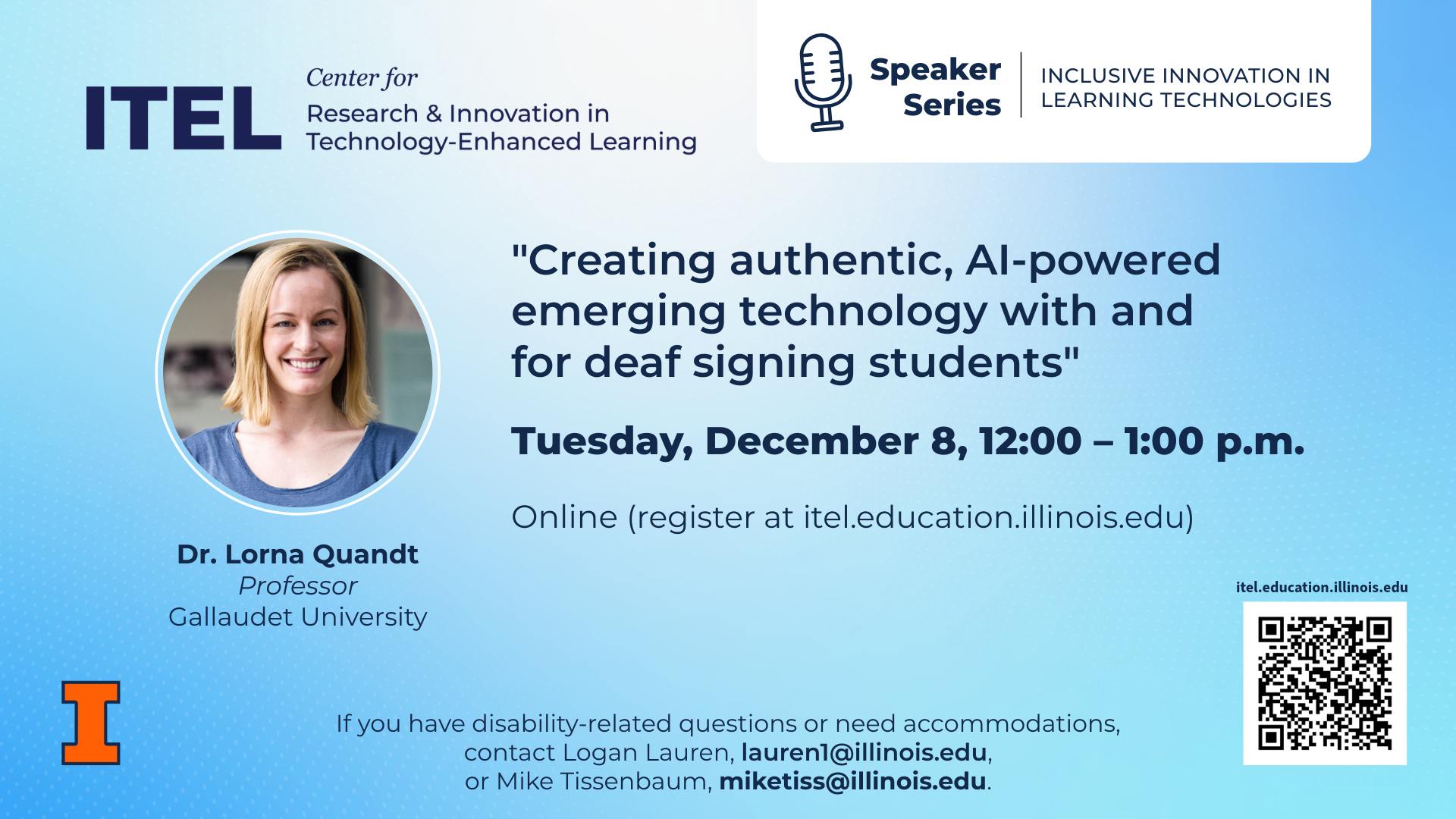
"Creating authentic, AI-powered emerging technology with and for deaf signing students" with Dr. Lorna Quandt
Emerging technologies, including artificial intelligence (AI), virtual reality (VR), and augmented reality (AR), offer new opportunities to create accessible, engaging, and effective learning experiences for deaf signing students and sign language learners. But how can we ensure that these technologies are grounded in research on learning and cognition, while also reflecting the linguistic and educational needs of deaf learners? In this talk, Lorna Quandt will highlight three research projects that approach this challenge from complementary perspectives: SAIL, which integrates AI-powered sign language recognition with immersive VR environments to support ASL learning; BRIDGE, which explores AI and AR technologies to improve access to classroom communication and STEM learning in mixed deaf and hearing educational settings; and MATRIX, which uses immersive AR and multisensory learning experiences to support deaf students' understanding of complex STEM concepts, including lunar phases. Across these projects, Quandt will discuss how cognitive neuroscience, learning sciences, and human-computer interaction can inform the development of emerging educational technologies, and why authentic collaboration with deaf researchers, educators, and learners is essential to creating tools that are both innovative and educationally meaningful.

Join online
Tuesday, December 8, 2026
12:00-1:00 PM Central Time
Accessibility
We are anticipating the need for, and hope to provide, American Sign Language interpreters for this event; if you will need ASL interpretation, please contact us to confirm.
This event is online only. Registration via Zoom is required to receive the meeting link. A transcript and recording will be available after the event to everyone who registered.
If you have questions or need additional disability-related accommodations, please reach out to Logan Lauren, lauren1@illinois.edu, or Mike Tissenbaum, miketiss@illinois.edu.