Inaugural FLT Showcase

May 11, 2026 | 9:00 AM to 1:30 PM
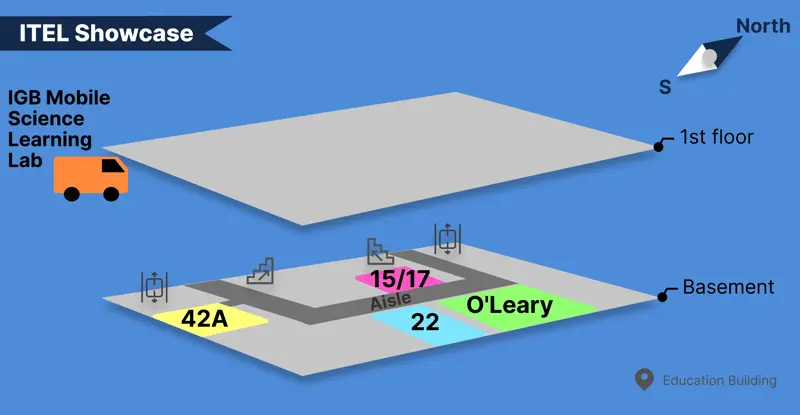
Education Building (1310 S. Sixth St., Champaign)
Agenda At-a-Glance
| Time | Event | Location |
|---|---|---|
| 9:00 AM | Welcome | Room 22 |
| 9:30 AM | Presentations | Room 22, O'Leary Center |
| 11:10 AM | Poster Session 1 | Rooms 22, 15/17, 42A, South Entrance |
| 12:10 AM | Light Lunch | O'Leary Conference (Room 10i) |
| 12:20 AM | Poster Session 2 | Rooms 22, 15/17, 42A, South Entrance |
9:30 to 11:00 AM - Presentations
There are two concurrent sessions of presentations in Room 22 and the O'Leary Center. Presentations are 15 minute slideshows about innovative learning technology research.
Room 22: Learning & Interaction Design
Scaling Virtual Global Engagement: Preparing Educators for Digital Teaching in Diverse Global Contexts
This paper presents IGlobal, a scalable Virtual Global Engagement model designed to prepare preservice teachers for digitally mediated, globally diverse learning environments. Addressing the gap between traditional teacher education and contemporary global realities, IGlobal engages participants from over 30 countries in collaborative, technology-supported learning centered on the United Nations Sustainable Development Goals. Preservice teachers facilitate real-time multinational instruction, developing skills in intercultural communication, adaptive teaching, and equitable technology use. Grounded in authentic practice rather than simulation, the model emphasizes aligning technology with societal needs. Findings indicate improved instructional flexibility and global competence, offering a sustainable framework for reimagining teacher preparation in interconnected educational contexts.
Using Data and Interactive Technology to “Connect the Dots” in Illinois’ Early Childhood System
Are you interested in how integrated data systems, interactive data visualization, and technology can drive smarter early childhood policy and research? This session showcases a suite of data tools developed by the Illinois Early Childhood Asset Map (IECAM) team that leverage linked administrative datasets. We will highlight how these platforms enable users to query, visualize, and interpret complex early childhood data in real time. Attendees will learn how researchers, policymakers, administrators, and practitioners can use these tools to address service gaps, generate insights, and support decision-making to strengthen early childhood systems in Illinois.
Designing Gesture-Augmented Instructional Video for Statistics
This proposal outlines the design of gesture-augmented instructional videos developed for supporting the learning of statistics, with a focus on central tendency, variability, and regression. Through this paper we share how gesture, acting as a representational and conceptual resource, is systematically integrated within video-based instruction. The aim is to articulate how instructional media can be designed to make complex abstract concepts more accessible, while also enabling learning through movement within an online video environment, where such affordances are often limited. This initiative contributes to ongoing efforts in education technology to move beyond static representations and toward multimodal, embodied forms of instruction.
A Unified System for Multimodal Data Synchronization and Analysis
Multimodal learning analytics (MMLA) and multimodal large language models (MLLMs) provide complementary approaches for analyzing collaborative learning, yet both depend on the alignment of heterogeneous data streams. In practice, video, transcripts, and interaction logs are often collected asynchronously, requiring substantial preprocessing. This demo presents a graphical user interface (GUI)-based system for multimodal data synchronization, visualization, and analysis within a unified environment. The system integrates a shared timeline for cross-modal alignment, fine-grained temporal control, post hoc synchronization through virtual timestamp mapping, and exportable synchronized datasets. It further supports human-in-the-loop analysis through coordinated visualizations and integrates a local LLM agent for time-referenced multimodal querying. Additional capabilities include video anonymization and pipeline-ready data outputs. Rather than reporting empirical results, this work focuses on system design and analytic affordances, positioning the platform as infrastructure for scalable and theory-aligned MMLA and MLLM workflows.
What do we build when we don't need to code? Vibe Coding and Computational Action in a Middle School Summer Camp
This paper presents a one-week summer computing camp where middle school students build web applications through “vibe coding,” using generative AI instead of traditional programming. Grounded in constructionism and the computational action framework, the camp emphasizes creativity, agency, and meaningful problem-solving over technical skill acquisition. By reducing coding barriers, students can focus on design, iteration, and impact. The project also introduces a multi-method assessment approach to capture identity, empowerment, and design in AI-supported environments. Findings will contribute to understanding how computing education can evolve to become more accessible, meaningful, and aligned with the realities of an AI-driven future.
O'Leary Center: AI & Learning
Writing-to-Learn Versus Beneficial Cognitive Offloading With and Without ChatGPT: Comparing Processes and Outcomes
GAI effects on learning have been framed within practice or beneficial cognitive offloading perspectives. We test the extent to which these explain during-reading and during-writing processes and posttest inferential scores in an experiment with 120 postsecondary students. Participants read and then wrote about childhood vaccination using ChatGPT or Word. Analyses showed few differences in strategies during the reading phase and many differences during the writing phase. Using transformative strategies when reading what ChatGPT output is similar to the deep cognitive processing predicted by beneficial cognitive offloading. Posttest inferential scores were the same, and ChatGPT essays received higher rubric scores.
Lucy: An AI-Based Simulated Client for Scalable, Low-Stakes Communication Practice
This paper presents Lucy, an AI-based simulated client designed to provide undergraduate students with low-stakes, authentic practice communicating financial-planning recommendations. Embedded within a course assignment, Lucy was evaluated using pre/post surveys, usability measures, and student reflections. Consistent with prior research on AI-mediated simulations (Chiu et al., 2025; Luo et al., 2025), students reported increased communication confidence, clearer explanations, and meaningful metacognitive growth when system performance was stable. However, technical instability emerged as a significant barrier, raising concerns about equity, consistency, and scalability. Findings highlight both the pedagogical potential of AI simulations and the importance of reliable implementation in authentic learning environments.
Time-on-AI Grading: AI-Estimated Effort for Open-Ended Student Projects
AI coding agents have broken specification-based programming assignments. When Claude Code can finish a project from its written specification alone, the grade measures the AI's work, not the student's. To respond, we redesigned both our assignment and how we grade it. After seven weeks of structured preparation, each of hundreds of CS 124 students designs and builds their own Android app with Claude Code. With no shared specification, we grade active development time instead, estimated by AI from Claude Code session logs and grounded in each student's project plan—an intuitive and fair way to grade an independent project.
Illinois Chat: An AI-Powered Platform for Teaching and Learning at Scale
Illinois Chat is a production-grade, AI-powered platform supporting teaching, learning, and research at the University of Illinois Urbana-Champaign. Launched in 2023 as an AI Teaching Assistant for computer engineering, it has evolved into a university-wide service enabling scalable, personalized support across disciplines. Using Retrieval-Augmented Generation, Illinois Chat grounds responses in course materials and institutional knowledge, allowing instructors to create course/domain-specific assistants without technical expertise. This presentation outlines the platform’s pedagogical motivation, technical architecture, adoption and impact across instructional and research workflows, and future directions for expanding access, reliability, and educational value at scale.
Designing AI as a Dialogic Feedback Partner in Human-Centered Design Education
What if AI didn’t just evaluate student work, but helped shape how students think? This paper presents CyberScholar, an AI-supported, rubric-aligned feedback system that reimagines feedback as an ongoing, dialogic process, positioning AI as a collaborative partner in design thinking. Designed for Human-Centered Design learning, the system engages students in iterative exchanges grounded in rubric criteria. Using a mixed-methods approach, the study analyzes student-AI interactions and survey data to examine patterns of engagement and feedback use. Findings show that students actively question, reinterpret, and build on AI feedback, highlighting its role in supporting co-creation, reflection, and transparent human-AI collaboration in learning.
11:10 AM to 12:10 PM - Poster Session 1
The first poster session is in Rooms 22, 15/17, and 42A. The IGB Mobile Science Learning Lab is also outside the South Entrance. Attendees can explore and experience innovative tools hand-on.
South Entrance
IGB Mobile Science Learning Lab: Delivering Science to Your Doorstep
Step aboard the IGB Mobile Science Learning Lab and see how we embrace our motto “Where Science Meets Society.” This self-contained laboratory on wheels was designed to bring authentic and customizable science experiences to students and communities who lack access to on-campus engagement. Instead, we literally bring the resources for biological research, including microscopes, specimens, and molecular laboratory equipment, to their doorstep. See how a little lab can have a big impact. From rural classrooms to the Illinois State Fair, we show up to share our science and foster curiosity.
Room 22: Immersive Learning
Integrating Augmented Reality and Product Design in Makerspaces
This study examines how augmented reality (AR) can support undergraduate students’ product design processes in a Makerspace‑based business course. The study focuses on students’ perceptions of interacting with three‑dimensional (3D) models in AR and how those interactions influence spatial reasoning and collaboration during design activities. The authors address well‑documented limitations of traditional computer‑aided design (CAD) tools, which require students to view and manipulate 3D objects on 2D screens, often placing heavy demands on imagination and mental rotation. Grounded in theories of spatial cognition and social constructivism, the study explores AR as a mediating technology that can support spatial reasoning and collaboration.
Rethinking Collaboration Through XR: Co-Designing Shared Experiences for Scientific Modeling
This interactive poster presents a co-design approach for supporting collaborative scientific modeling in extended reality (XR), particularly in settings with limited hardware resources. While XR offers powerful affordances for visualizing complex phenomena, many systems are designed for individual use, limiting opportunities for shared reasoning. We explore a single-headset configuration with a shared display that enables small groups to collaboratively design and refine scientific models. Grounded in an XR astronomy co-design activity, students engaged in spatial scientific reasoning, discussion, and iterative prototyping. We highlight how shared access and multimodal interaction support coordination and sensemaking, and invite reflection on how XR environments can be designed to better support collaborative learning.
Exploring Innovation Spaces and Immersive XR Learning with CITL
This interactive poster session invites participants to explore how campus innovation spaces supported by the Center for Innovation in Teaching and Learning (CITL) enable faculty experimentation with emerging learning technologies, with a focus on immersive extended reality (XR). Attendees engage hands-on with a functional XR learning tool—the Precision Liver Surgery Simulator—through guided demonstrations that illustrate how immersive environments can support experiential, spatial, and procedural learning. The session also introduces the X3 Studio and CITL Innovation Studio, highlighting how these faculty-facing spaces reduce barriers to adoption by providing access to technologies, design expertise, and collaborative support. The experience models pathways from curiosity to meaningful instructional integration of XR and related technologies.
[Abstract generated with Microsoft 365 Copilot based on the author(s) proposal]
Connections of Earth and Sky with Augmented Reality (CEASAR)
Connections of Earth and Sky with Augmented Reality (CEASAR) is an affordable, multi-device learning platform designed to support collaborative problem solving in astronomy education. Grounded in research on collaborative learning and immersive technologies, CEASAR integrates tablets and augmented reality headsets to provide complementary perspectives on celestial phenomena. Students work together to explore stars and constellations, annotate shared views of the sky, and reconcile multiple representations to solve open-ended problems. A featured learning task challenges groups to determine an unknown location using night sky observations. The platform scaffolds high-quality collaboration while leveraging immersive and embodied interaction to deepen understanding of spatial and astronomical concepts.
[Abstract generated with Microsoft 365 Copilot based on the author(s) proposal]
Room 15/17: Simulations for Learning
Human-Centered Design for Supporting Collaboration in STEM Simulations
Collaborative learning in STEM requires students to coordinate perspectives and sustain shared understanding, yet developing features to support computer-supported collaborative learning (CSCL) during these moment-to-moment interactions is difficult. This study applies a human-centered design (HCD) approach to iteratively refine design features within a simulation-based learning environment and examines how design changes influence usability, learning outcomes, and collaborative interaction. Across three design iterations involving undergraduate and secondary students, data from feedback, assessments, and interaction logs show that refinements improved measurement accuracy, reduced peer response times, and enhanced coordination, particularly among lower-performing groups. The study introduces collaborative initiative and collaborative awareness as indicators of coordination in co-located, non-synchronous environments. In this interactive poster demonstration, we plan to showcase V3 of our HCD collaborative science simulation.
Fostering Empathic Understanding Without Emotional Hijacking: Mapping the Mental Models of Empathic VR
Virtual Reality has been proposed as an empathy education tool, yet concerns persist about whether it elicits genuine empathy or merely imposes emotional and visceral stimuli that overwhelm users. This study addresses this debate through an intentionally constrained design: an emotionally neutral, baseline-immersive VR scenario depicting librarians' professional experiences, both patron-facing and behind-the-scenes. Results demonstrate that even without emotionally evocative elements, the 30-to-60-minute VR experience produced significant empathy enhancement, perspective shifts toward librarian stance, and deepened professional understanding. These findings validate VR's pedagogical capacity to foster authentic, understanding-based empathy and in-group perspective-taking independent of emotional manipulation.
Room 42A: Games & Embodied Learning
My Agrivoltaics Farm: Iterative Design of a Game Based Learning Environment to Promote Productive Failure and Hypothesis Testing
This talk explores the theoretical framework and iterative development of the “My Agrivoltaics Farm” mobile application as a part of the SCAPES project. The broader goal is to provide a resource for both education and extension related to agrivoltaics – a relatively new term which describes strategies involving the co-location of agricultural and photovoltaic development. Through an immersive farming simulation game designed to maximize fun gameplay alongside realistic data modeling, players are able to engage with novel science concepts, create and test hypotheses, and refine their strategies through the intrinsic motivation of game mechanics.
Reimagining Language Learning: A Multimodal, Gesture-Based Language Learning Pedagogy
This study introduces TooTak, a multimodal, gesture-based mobile app designed to support Persian language learning for children of Persian-speaking families in the diaspora. To address challenges such as right-to-left structure, similar letter forms, and pronunciation challenges, the app integrates visual, auditory, and kinesthetic interactions through game-based activities. The project uses design-based research and qualitative analysis of family interactions over an 8–12-week period. Preliminary findings show strong engagement, with learners using gestures to recall letters, connecting Persian and English, and extending learning beyond the app. The research approach highlights the potential of culturally relevant, interactive tools for language learning.
Master Dancer “Virtual Reality Dance Adventure”
[Not Available]
12:20 to 1:20 PM - Poster Session 2
The second poster session is in Rooms 22, 15/17, and 42A. The IGB Mobile Science Learning Lab is also outside the South Entrance. Attendees can explore and experience innovative tools hand-on.
South Entrance
IGB Mobile Science Learning Lab: Delivering Science to Your Doorstep
Step aboard the IGB Mobile Science Learning Lab and see how we embrace our motto “Where Science Meets Society.” This self-contained laboratory on wheels was designed to bring authentic and customizable science experiences to students and communities who lack access to on-campus engagement. Instead, we literally bring the resources for biological research, including microscopes, specimens, and molecular laboratory equipment, to their doorstep. See how a little lab can have a big impact. From rural classrooms to the Illinois State Fair, we show up to share our science and foster curiosity.
Room 22: Designing with AI
Keating: An AI-Powered Educational Assistant for Grounded Classroom Analytics
Keating is an early-stage conversational AI prototype that helps teachers query student performance through natural language. Modern classrooms generate more academic and behavioral signals than teachers can act on, yet applying LLMs directly to educational data risks hallucinated metrics. Keating addresses this by separating data retrieval from language generation: numerical facts are queried deterministically from an analytics database, while local open-source LLMs handle question interpretation and pedagogical reasoning. The system combines a planning agent, classroom and coding-session data agents, a RAG-based pedagogy agent, and a composer that grounds responses in retrieved evidence. Evaluation uses synthetic classroom and coding-session data.
Canvas MCP - Bridging AI Assistants and Learning Management Systems Through Open Protocols
Canvas MCP is an open-source system that connects AI assistants with the Canvas Learning Management System using the Model Context Protocol, enabling natural-language interaction with course data. By exposing structured Canvas functionality through standardized tools, the system allows students, educators, and learning designers to complete common LMS tasks conversationally within AI environments they already use. Students can track assignments and grades, educators can manage submissions and communicate at scale with privacy safeguards, and learning designers can audit courses for accessibility and structure. Deployed in live university courses, Canvas MCP demonstrates how open protocols can bridge AI assistants and institutional systems, reducing friction, increasing transparency, and improving the usability of LMS data for teaching and learning.
[Abstract generated with Microsoft 365 Copilot based on the author(s) proposal]
From Understanding to Action: Interactive Tools as a Mechanism for Learning and Decision-Making in Financial Education
Generative AI is rapidly reshaping research methodologies, yet its application as a qualitative data collection instrument remains nascent. An open-source, Python-based AI chatbot was adapted by a non-programmer to conduct text-based qualitative interviews within a mixed-methods dissertation study on financial education. The chatbot guided 132 participants through a structured interview exploring experiences with visual media, self-regulated learning, interest, and engagement. Deployed as a standalone web application, the tool demonstrated both strengths and limitations as a research instrument. Interact directly with the chatbot and explore the opportunities and challenges of AI-enabled interviewing as a scalable approach to qualitative data collection.
CyberScholar: An AI-Supported, Multimodal Workspace for Transparent Human-AI Collaboration in Learning
CyberScholar is an AI-supported, multimodal workspace designed to make human–AI collaboration in learning transparent, accountable, and pedagogically grounded. Rather than relying on unreliable detection tools, CyberScholar shifts from detection to disclosure by making AI use visible throughout the knowledge-creation process. Built on the widely used CGScholar platform, it integrates AI-supported brainstorming, rubric-aligned feedback, peer review, analytics, and collaborative course spaces within a single workflow. Its patent-pending architecture tracks human and AI contributions while keeping educators in control of criteria and feedback. Classroom evidence shows that CyberScholar supports iterative revision, learner independence, and reduced instructor workload, positioning AI as a transparent learning partner rather than an opaque shortcut.
[Abstract generated with Microsoft 365 Copilot based on the author(s) proposal]
Room 15/17: Interactive Tools for Learning
Designing an AI-Augmented Knowledge Synthesis Tool for Collaborative Learning
Knowledge synthesis involves the deliberate integration of diverse information to generate new insights and creative solutions. In CSCL, it is both a process—where students advance collaborative knowledge—and a product that facilitates ongoing learning. We introduce a novel technology that scaffolds students’ knowledge synthesis in collaborative learning environments augmented by generative AI. The project presents its design rationale, technical details, and future directions for iterative development and classroom implementation to support knowledge synthesis in CSCL.
Net.Create: Network Visualization for Disciplinary Data Literacy
We will demonstrate the potential of Net.Create for supporting disciplinary data literacy, particularly in History and ELA. Net.Create is an open-source, NSF-funded network visualization tool designed to support students in collaboratively creating, editing and viewing networked data. Network visualizations consist of “nodes” that represent people, places, things, or ideas, and the connections between those nodes called “edges.” These visualizations can help analysts to see the many relationships within a data set, or to look at particular entities in greater detail. We’ll also show the potential of tools like this for encouraging personally relevant connections to data and content.
Room 42A: Community-based Learning
Playing Heritage in Museums: Designing for Visitors Who Know More Than You Do
Games and interactive exhibits engage visitors as players, but learning remains one-directional: content flows from designers outward. This deployment flips the script. We built a 3D reconstruction of Nicosia International Airport (sealed inside Cyprus's UN buffer zone since 1974) and embedded it in a museum for two years. The reconstruction commits claims and materials for visitors to contest or extend using their own expertise; the technology elicits knowledge rather than delivering it. Across 3,510 sessions, over 132 visitors reshaped the model through self-directed play. We collected social and labor histories no archive contained. See a live demo of the deployment.
Connected Spaces Technologies: Supporting Distributed Makers' Computational Action
Connected Spaces Technologies is a suite of learning tools designed to support distributed makers’ computational action through identity, empowerment, collaboration, and design thinking. Grounded in constructionism and the theory of computational action, the project was implemented across four years of summer maker camps connecting multiple community-based sites and a remote mentor makerspace. The suite includes a Dashboard for identity expression and help-seeking, the REACH projector system for embodied remote collaboration, and a Work-In-Progress Carousel for reflection and design iteration. Together, these technologies scaffold meaningful, community-connected making experiences and demonstrate how embodied, multimodal, and networked tools can support collaborative computational learning across physical distances.
[Abstract generated with Microsoft 365 Copilot based on the author(s) proposal]
MSTE Digital Projects Sampler Platter
Stop by our booth to see some of the hands-on activities we’ve developed to connect STEM research with precollege education! Featured projects include Digital Tools in Agriculture, where middle school students become “digital farmers” using sensors and coding to care for plants; cybersecurity education through robot-based activities that explore the pitfalls of communicating across open networks and the importance of encryption; and Power Park, a hands-on book and kit series focused on circuits, coding, and energy systems. Visit our website to find many freely available STEM education resources: https://mste.illinois.edu/resources

Accessibility
The Showcase will take place in-person. Unfortunately, no hybrid or online option will be available this year.
The Education Building has an automated ADA entrance on the west side, and elevators on the north and south ends of the building with vertical ADA call buttons that reach the floor. The first and basement floors have ADA-accessible men's, women's, and all-gender bathrooms. A lactation room is available on the first floor, and a meditation/prayer room is available on the third floor. Maps and more information is available on the Facility Access Maps (Building Code 160: Education Building).
Please notify Mike Tissenbaum (miketiss@illinois.edu) or Logan Lauren (lauren1@illinois.edu, 208-651-6435) if you have questions or will need additional accommodations for accessibility.